


Secure packaging for delicate plants
Small business in Berlin
★★★★★ 4.87 Avg. Review


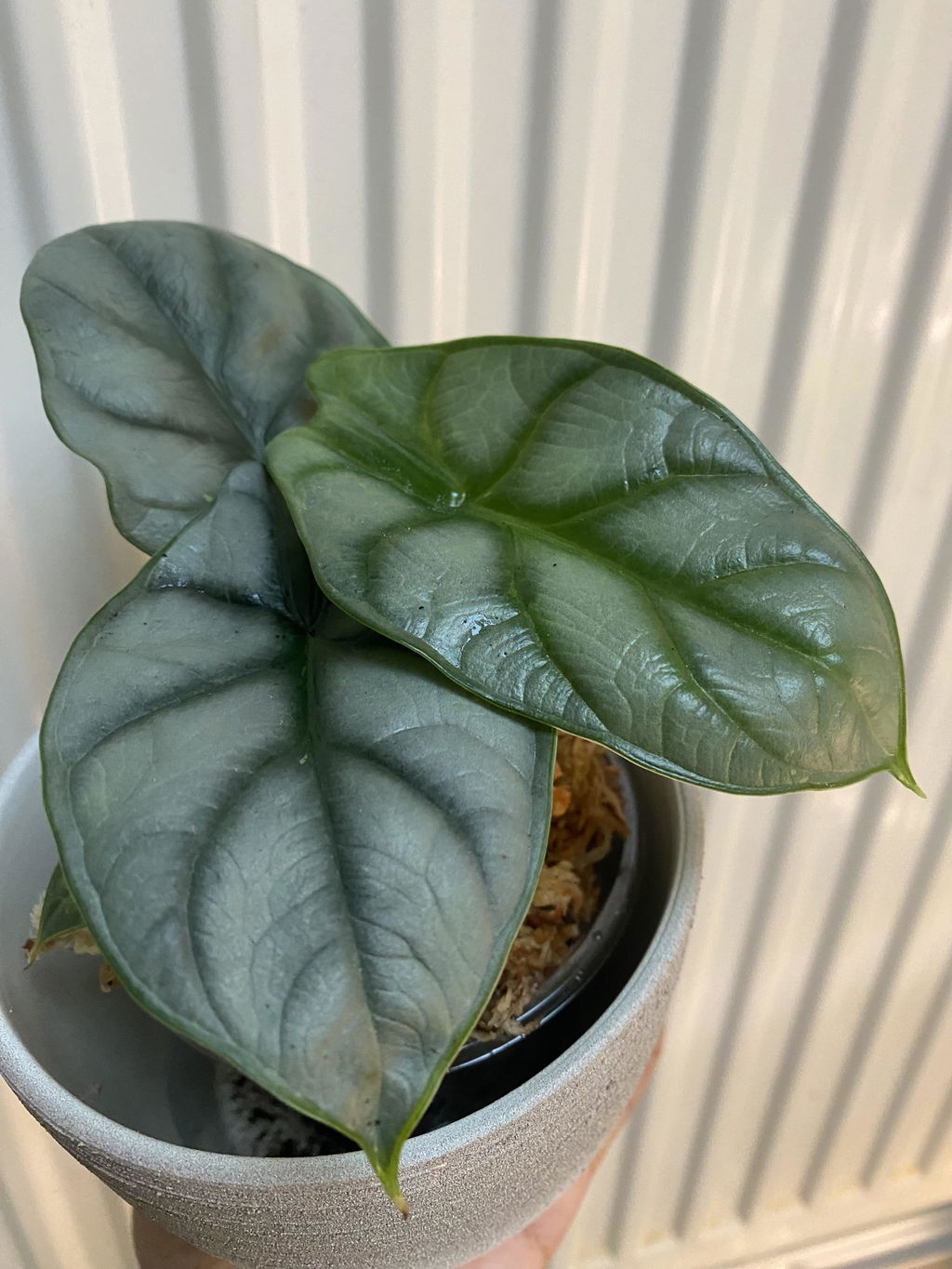
Alocasia baginda 'Silver dragon'
Alocasia baginda 'Silver Dragon' (Alocasia baginda 'Silver dragon') is a compact jewel Alocasia with a rhizomatous growth habit, notable for silvery interveinal fields and strongly bullate, dragon‑scale leaf texture set off by dark primary veins. It stays small and upright in shallow pots, suiting collectors or anyone seeking striking, jewel‑like foliage for shelves or desks; however it is toxic to pets and children and prefers bright, humid conditions.
- height Height
- 12 cm
- swap_horiz Pot Size
- 6 cm
- volunteer_activism Care
- Medium
- wb_sunny Light Needs
- Bright indirect light
- pets Not Pet Friendly
- water_drop Watering Needs
- Medium
check_circle In Stock
Quick care table
Plant care at a glance
- Botanical name
- Alocasia baginda 'Silver Dragon'
- Common name
- Silver Dragon Alocasia, Alocasia Silver Dragon, Silver Dragon, Jewel Alocasia, Dragon Scale Alocasia, and Alocasia baginda 'Silver dragon'
- Difficulty
- Medium
- Light
- Bright indirect light
- Water
- Medium
- Humidity
- Medium
- Pet safe
- No, toxic if ingested
- Growth habit
- Upright
- Best for
- Indoors, Living room, Bedroom, Bathroom, Kitchen, Hallway, and Office
Silver interveinal sheen and dragon‑scale texture — Alocasia baginda 'Silver dragon'
Leaves read like armour: broad, thickly leathery lamina with pale silvery interveinal fields set off by dark, almost black primary veins. The surface is strongly bullate, giving a three‑dimensional ‘dragon‑scale’ effect, and the overall silhouette is a compact fan of ovate, non‑fenestrate leaves that catches light with a metallic sheen.
Development is typically compact and terrestrial: new leaves often unfurl with the brightest silvery sheen and may mellow as they mature, and juvenile plants can appear greener until the silver develops. This selected cultivar grows from short decumbent rhizomes/corms rather than as a climber, so you’ll see a small upright habit rather than vines or perforated leaves; growth commonly slows in cooler, short‑day months.
In ownership this cultivar rewards attention: collectors value the silver versus dark‑vein contrast and its use in breeding, and many growers appreciate the small ‘jewel’ habit for limited spaces. Expect sensitivity to low humidity and to overwatering (a real trade‑off: vivid foliage demands consistent conditions), and note the plant is toxic if chewed—keep away from pets and children.
Best suited to bright, indirect locations where its metallic surface is visible; choose the Baby size as a grow‑on or desk option and the Medium for a fuller display on a shelf or side table. As a selected cultivar with an established commercial presence, it’s widely available through specialist nurseries rather than a one‑off rarity.
Shipping Information
expand_more
- All orders are subject to a €25 minimum order value requirement
- All orders are hand-picked and shipped from the Netherlands
- Plastic-free materials when possible
- Orders are usually processed in 1-3 working days and shipped via DPD and their international partner carriers
- At times, orders may take up to 7 days to ship
- Orders to Germany Free shipping over €60. Free shipping all other EU countries* at €100 (Except Malta and Cyprus)
- Shipping costs are calculated at checkout based on delivery country:
See our FAQ and Shipping Guarantee for any further Questions!

Size: Baby - P6 H12


Plant questions, answered
What makes Alocasia baginda 'Silver Dragon' different from other Alocasias?
expand_more
Usually, Alocasia baginda 'Silver Dragon' is noted for silvery to pale-grey interveinal fields combined with strongly bullate (‘dragon‑scale’) texture and dark primary veins. This selected cultivar produces thick, coriaceous leaves in a compact jewel habit, giving a high‑contrast, three‑dimensional look that collectors prize; expect the usual jewel‑Alocasia care needs (humidity, bright indirect light).
How does 'Silver Dragon' compare to Alocasia baginda 'Dragon Scale' or Alocasia reginula ('Black Velvet')?
expand_more
Usually, compared with the sister cultivar 'Dragon Scale', 'Silver Dragon' shows paler, more extensive silvery interveinal fields while keeping strong dark veins and bullation. Versus Alocasia reginula ('Black Velvet'), the differences are clear: 'Black Velvet' is much darker overall with different venation contrast and often a coloured leaf underside, so the silvery sheen and armour‑like texture identify 'Silver Dragon'.
Is Alocasia baginda 'Silver Dragon' suitable for small apartments or desks?
expand_more
Yes. The plant has a compact jewel habit and is offered in size options meant for small spaces: Baby (P6 H12) works well on a desk, small shelf or as a grow‑on option, while Medium (P12 H25) gives greater visual impact on a shelf or side table. Choose based on display space and desired presence.
What light, humidity and watering does Alocasia baginda 'Silver Dragon' need?
expand_more
Usually, this cultivar prefers bright, indirect light and higher humidity (most guides recommend 60%+). Keep the substrate evenly to lightly moist and allow the top portion of the mix to dry slightly between waterings; avoid prolonged waterlogging. Practical implication: bright filtered light and a humidifier or grouping with other plants help keep leaf margins healthy.
Is Alocasia baginda 'Silver Dragon' safe for homes with pets or children?
expand_more
No. Like other Alocasias, Alocasia baginda 'Silver Dragon' contains insoluble calcium oxalate crystals that cause oral and dermal irritation if chewed or handled improperly. Keep the plant out of reach of pets and small children and supervise handling; wear gloves if you need to repot or divide offsets.
Will the silver sheen on leaves stay the same as the plant grows?
expand_more
Usually, new leaves often unfurl with a pronounced silvery sheen that can change as the leaf matures; intensity commonly varies with light level, leaf age and selection. Juvenile or very new leaves may appear greener. Practical implication: brighter, indirect light tends to enhance the metallic effect, but avoid direct sun to prevent scorch.
What common problems should I watch for with 'Silver Dragon' and how can I reduce them?
expand_more
Usually, the main issues are spider mites and mealybugs in dry air, root/corm rot from soggy substrate, yellowing from overwatering, and crispy margins from low humidity or sun scorch. Improve humidity, ensure a well‑draining aroid mix and avoid prolonged waterlogging; inspect regularly for pests and treat early if found.
Plant care guide
Light
expand_more
Water
expand_more
Soil and repotting
expand_more
Humidity and temperature
expand_more
Feeding
expand_more
Growth and support
expand_more
Common concerns
expand_more
Watch for spider mites and mealybugs in dry air; avoid prolonged waterlogging to prevent corm/root rot. Yellowing often signals overwatering; crispy leaf edges indicate low humidity or sun scorch. Growth slows in cool or very low‑light conditions.
Pet safety
expand_more
You might also like
Beautiful little plant in perfect condition.
Beautiful plants and excellent customer service
Reviews in Other Languages
Schnelle Lieferung. Perfekt verpackt, schöne Pflanze
Superschön, gesund, schon viele Blätter
Sehr große Pflanze bekommen. super verpackt, alles bestens!