

Secure packaging for delicate plants
Small business in Berlin
★★★★★ 4.87 Avg. Review


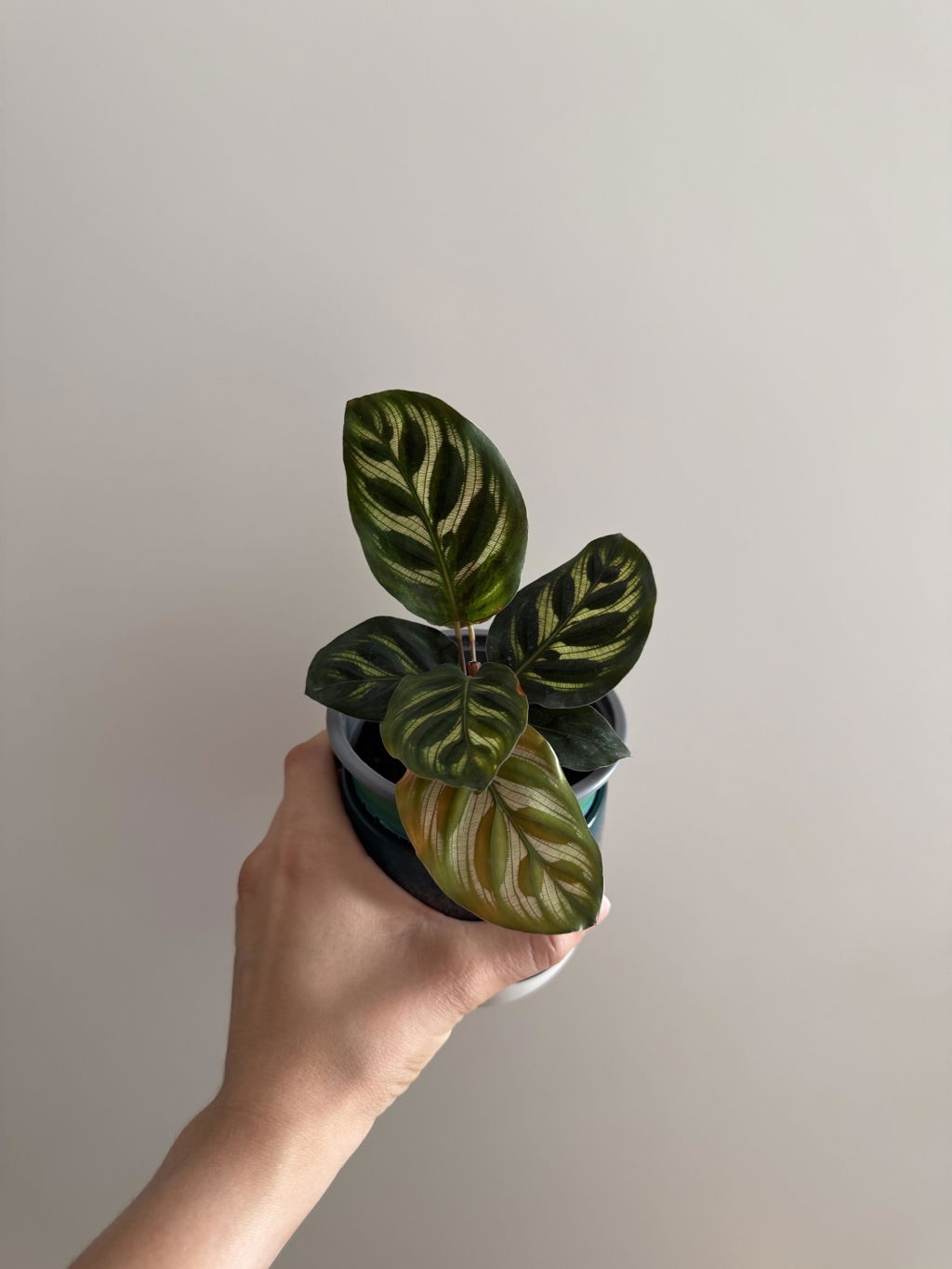
Goeppertia (Calathea) Makoyana
Goeppertia (Calathea) Makoyana is the peacock plant, an evergreen, clump-forming indoor foliage plant noted for its broad, feather‑like green patterning and purple undersides. Goeppertia makoyana forms a compact upright rosette that shows nightly leaf folding (nyctinasty) and suits bright, humid indoor spots; it is generally non‑toxic for homes with pets. It dislikes low humidity and hard or chlorinated tap water, which often causes brown leaf edges.
- height Height
- 12 cm
- swap_horiz Pot Size
- 6 cm
- volunteer_activism Care
- Medium
- wb_sunny Light Needs
- Indirect light
- pets Pet Friendly
- water_drop Watering Needs
- Medium
check_circle In Stock
Quick care table
Plant care at a glance
- Botanical name
- Goeppertia makoyana
- Common name
- Peacock plant, Peacock calathea, and Cathedral windows
- Difficulty
- Medium
- Light
- Indirect light
- Humidity
- Medium
- Pet safe
- Yes, non-toxic to pets
- Best for
- Indoors
Peacock-patterned Goeppertia (Calathea) Makoyana — feathered foliage
Leaves are broadly ovate with a regular, feather‑like banding of lighter and darker greens running either side of the midrib, giving the clear ‘peacock feather’ look shoppers expect. Turn a leaf over and you’ll see the plum to deep purple underside; the thin, soft lamina feels slightly velvety and sits on fine, slender petioles from a compact basal clump.
Indoors it stays upright and clump‑forming rather than vining, and you’ll notice daily movement: the leaves fold or lift at night (nyctinasty) and open again by morning. Leaves do not develop splits or holes as they mature — the shape remains broadly ovate — and stressed plants show reduced night movement and some drooping when thirsty.
In real homes this species grows at a moderate pace and rewards steady humidity; low humidity or hard/fluoridated tap water commonly causes brown edges or curled margins, so that is the main trade‑off to accept. It is generally regarded as non‑toxic to cats and dogs, and because of its patterned upper surface and purple undersides many buyers keep it where its colour contrast can be seen.
Good for a bright, indirect spot in bathrooms, bedrooms or living areas. Size choices change the experience: a Baby pot suits a small shelf or desk and is a grow‑on option, a Medium sits well on a side table, and a Large provides a fuller display and greater visual impact.
Shipping Information
expand_more
- All orders are subject to a €25 minimum order value requirement
- All orders are hand-picked and shipped from the Netherlands
- Plastic-free materials when possible
- Orders are usually processed in 1-3 working days and shipped via DPD and their international partner carriers
- At times, orders may take up to 7 days to ship
- Orders to Germany Free shipping over €60. Free shipping all other EU countries* at €100 (Except Malta and Cyprus)
- Shipping costs are calculated at checkout based on delivery country:
See our FAQ and Shipping Guarantee for any further Questions!

Size: Baby - P6 H12


Plant questions, answered
How does Goeppertia makoyana (Peacock plant) differ from other Calathea/Goeppertia houseplants?
expand_more
Goeppertia makoyana is a species valued for its symmetric, feather‑like pale and dark green bands on the upper leaf surface and a contrasting plum‑purple underside. It shows pronounced nyctinastic (night) leaf folding and keeps a broad ovate leaf shape, unlike G. ornata’s fine stripes or G. orbifolia’s round, parallel‑veined leaves. This makes it a classic choice for foliage collectors, and it is a commonly available species rather than a rare cultivar.
Is the Peacock plant safe for homes with cats and dogs?
expand_more
Yes — Goeppertia makoyana is generally regarded as non‑toxic to cats and dogs. Veterinary and extension compilations list Calathea/Goeppertia species as pet‑safe, though any plant material can irritate if chewed. Keep plants out of reach of persistent nibblers and consult a vet if a pet consumes large amounts.
What light and humidity conditions bring out the best pattern on Goeppertia makoyana?
expand_more
Bright, indirect light and elevated humidity are best to maintain strong leaf contrast on Goeppertia makoyana. It tolerates lower light but the distinctive feather pattern and colour contrast are most vivid in filtered/brighter shade. Aim for higher indoor humidity (commonly recommended around 50–70%); low humidity often causes brown edges and leaf rolling.
Why are my Makoyana leaves folding or drooping, and when is that normal?
expand_more
Nighttime leaf folding (nyctinasty) is normal for Goeppertia makoyana; reduced movement or drooping usually signals stress. Daytime droop, curled margins or brown edges commonly indicate low humidity, underwatering, or sensitivity to hard/fluoridated water. Check humidity and watering practices, and inspect for spider mites in persistently dry indoor air.
Which plant size should I choose and what will I receive?
expand_more
Choose by how much presence you want: Baby (P6, H12) is suitable for a small shelf or desk; Medium (P14, H45) fits a shelf or side table but is currently out of stock; Large (P17, H65) offers a fuller display and greater visual impact. All sizes arrive as clumping, upright plants and may be repotted as they grow.
Plant care guide
Light
expand_more
Water
expand_more
Soil and repotting
expand_more
Humidity and temperature
expand_more
Feeding
expand_more
Growth and support
expand_more
Common concerns
expand_more
Brown or crisp leaf edges commonly indicate low humidity or damage from hard/fluoridated tap water; leaf curling and droop point to underwatering or dry air; spider mites can appear in persistently dry indoor conditions; leaf scorch results from direct sun exposure.
Pet safety
expand_more
You might also like
I couldn’t be happier with my Calathea makoyana! It arrived in perfect condition, well-packaged, with no damage to the leaves or soil.
This was my first time ordering a plant online, and the whole experience was smooth and professional. I’ll definitely be coming back for more! Highly recommend for anyone looking to add a statement plant to their indoor jungle.