
Pet Friendly Plants
Secure packaging for delicate plants
Small business in Berlin
★★★★★ 4.87 Avg. Review
Secure packaging for delicate plants
Small business in Berlin
★★★★★ 4.87 Avg. Review
Secure packaging for delicate plants
Small business in Berlin
★★★★★ 4.87 Avg. Review
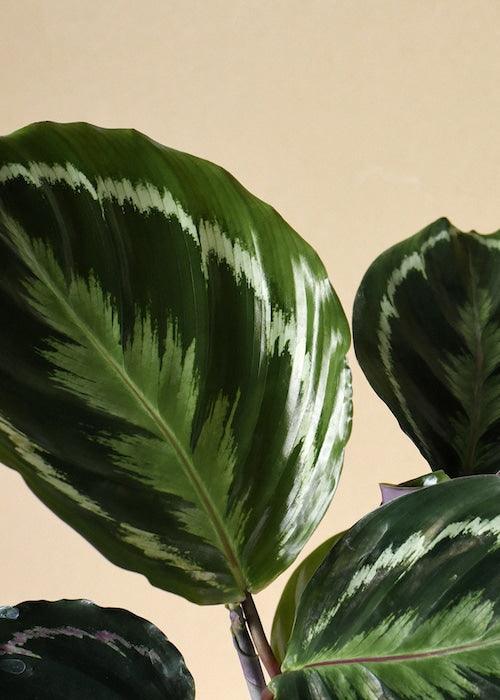
Goeppertia (Calathea) 'Medallion' is an evergreen, upright clumping prayer plant (Goeppertia roseopicta 'Medallion') with round leaves showing a lighter central “medallion” and vivid magenta undersides. It makes an attractive indoor foliage plant with nightly leaf-folding, suitable for living rooms and pet households (commonly reported non-toxic), but needs consistently moist soil and high humidity so expect attentive watering and humidity care.
check_circle In Stock
Quick care table
| Care factor | Goeppertia (Calathea) 'Medallion' |
|---|---|
| Botanical name | Goeppertia (Calathea) roseopicta 'Medallion' (sold/traded as Calathea 'Medallion') |
| Common name | Prayer plant, Calathea 'Medallion', Medallion (roseopicta), and Peacock plant |
| Difficulty | Medium |
| Humidity | Medium |
| Pet safe | Yes, non-toxic to pets |
Goeppertia (Calathea) 'Medallion' shows broadly rounded, glossy leaves with a lighter central “medallion” or silvery banding that contrasts with a darker green outer margin. The undersides are a vivid magenta to deep purple, and the midrib and veins are visible, giving a brush‑stroke effect across the blade. The overall silhouette is upright and clumping, with leaves forming a compact, arching rosette.
Young plants carry smaller, less pronounced medallion markings; as it matures the leaves grow larger and the central contrast becomes more defined. Leaves demonstrate classic prayer‑plant movement — they fold or lift at night (nyctinasty) — and the plant keeps an upright, non‑vining habit that does not require staking.
This selected cultivar is widely traded and popular with collectors for its clear central pattern and colourful undersides. In everyday ownership expect to manage humidity and even moisture: inconsistent watering or dry air commonly causes leaf‑edge browning and curling, and the plant is sensitive to prolonged waterlogging which can lead to root rot. It is generally reported as non‑toxic to cats and dogs, but it can attract pests like spider mites or mealybugs if conditions are poor.
Best suited to bright, indirect light on a shelf, side table or desk; choose a medium size for a compact desk or grow‑on option and a larger size for a fuller display with more mature leaves and stronger pattern impact.
Shipping Information
expand_moreSee our FAQ and Shipping Guarantee for any further Questions!
Size: Medium - P14 H50
What makes Goeppertia (Calathea) 'Medallion' different from other Calatheas?
expand_moreThis selected cultivar is prized for a pronounced lighter central 'medallion' on rounder leaves combined with a deep magenta underside, rather than the feathered patterns of some relatives. Goeppertia (Calathea) roseopicta 'Medallion' is an established, widely traded cultivar; pattern contrast and leaf size typically increase as the plant matures, and it needs moderate humidity and consistent moisture.
Is Goeppertia (Calathea) 'Medallion' safe for pets?
expand_moreYes — Goeppertia (Calathea) 'Medallion' is commonly reported as non‑toxic to cats and dogs and the Calathea/Goeppertia group is listed as non‑toxic by the ASPCA. Still take normal precautions: chewing can cause stomach upset, and individual animal reactions can vary.
Why are the leaf edges browning or curling?
expand_moreLeaf‑edge browning or curling is usually caused by low humidity or inconsistent watering. Other contributors include fluoride/salts in tap water, poor drainage that stresses roots, and pests such as spider mites or mealybugs. Check humidity, water quality and potting‑mix drainage and adjust conditions rather than changing light levels.
Are the leaves supposed to fold at night?
expand_moreThis is normal: Goeppertia (Calathea) 'Medallion' performs nyctinastic movement — its leaves fold or lift at night like other prayer plants. The nightly movement is natural and not a sign of poor health; it also reveals the vivid magenta underside and can enhance the plant's visual impact.
Which size should I choose: Medium (P14 H50) or Large (P19 H80)?
expand_moreMedium (P14 H50) suits a shelf, side table or desk and offers a compact display, while Large (P19 H80) delivers a fuller focal plant with greater visual impact. Choose Medium for smaller spaces or to start a collection, and Large when you want a stronger living‑room presence.
How does Medallion compare to the so‑called 'Peacock plant' (Goeppertia makoyana)?
expand_moreMedallion differs from Goeppertia makoyana by its singular central 'medallion' pattern and rounder leaves; makoyana shows a repeating feather‑like pattern across the blade. If you prefer bold central contrast and a striking magenta underside, Goeppertia (Calathea) 'Medallion' offers that clearer visual effect.
Light
expand_moreWater
expand_moreSoil and repotting
expand_moreHumidity and temperature
expand_moreFeeding
expand_moreGrowth and support
expand_moreCommon concerns
expand_moreNormal night-time leaf folding (nyctinasty); leaf-edge browning or curling from low humidity, fluoride/salts in water, or inconsistent watering; root rot if kept waterlogged or in poorly draining mix; susceptibility to common pests such as spider mites and mealybugs.
Pet safety
expand_more
by Plant Circle
Beginner Plant Care 101: Light, Water, Soil & Signs Your Plant Needs Help
A calm, beginner-friendly guide to light, watering, soil, and early stress signs so you can keep your first houseplants alive and adjust care with confidence.
Read more
by Plant Circle
Green and Safe: Discover the Top Pet-Friendly Calatheas for Your Home!
Pet-Friendly Plants That Make Your Home a Jungle—Safely! 🐾🌿Got pets and a passion for plants? You don’t have to compromise. Calatheas are non-toxic beauties that bring lush vibes without the risk. From the bold ‘Medallion’ to the dreamy ‘White Fusion’, we spotlight five stunning, pet-safe picks that will keep tails wagging and leaves thriving. 🌱💚
Read more
by Plant Circle
Why Do Calatheas Love to Die? (And What to Get Instead If You're Tired of the Drama)
Stop trying to make Calathea happen. It’s not going to happen. Let’s all take a moment of silence for the latest calathea you brought home with such hope in your heart… and found shriveled into a crispy relic of its former self two weeks later. You misted it. You spoke to it. You gave it filtered water collected under a full moon, and still—“my favorite thing to do is die,” whispered the calathea, as it dropped another leaf and gaslit you into thinking it was your fault. Thanks to Reddit sage new_butterfly223, we can now confirm: calatheas know what they’re doing. They are dramatic. They are beautiful. And they are the most high-maintenance plant roommates you could ever invite into your home. Somehow, despite all this, every grocery store and Baumarkt in the country seems to have Calatheas for days—just sitting there like botanical sirens, luring you into yet another heartbreak. We all start out the same: enchanted by those gorgeous patterned leaves, ready to become a calathea parent. But soon you’re googling “why is my calathea sad” at 2am, surrounded by a graveyard of humidity trays and emotionally shattered fiddle leaf figs who are just happy someone else is the problem child now. Sound familiar? If you’re stressed about keeping your Calathea alive, you’re definitely not alone. These plants belong to the Marantaceae family (including Maranta and Stromanthe) and are notorious for being picky about light, water, and humidity levels. Signs Your Calathea Is Plotting Something Brown edges? Emotional manipulation. Curling leaves? Passive-aggressively asking for a raise in humidity. Yellowing? They read your aura and didn’t like it. Flourishing? Just kidding, it’s storing energy for a dramatic decline. Let’s be honest: we still love them. But sometimes, self-care means realizing calatheas are the plant version of a toxic situationship, and you deserve better. If you're brave enough to keep trying (respect!), we’ve got some tips that might actually help. Check out our Calathea care guide for advice on humidity, light, and keeping the drama to a minimum. Bonus tip: Calatheas are pet friendly! So if you’ve got curious cats or mischievous dogs, they’re in the clear. Aglaonemas, on the other hand—while much easier to keep alive—are unfortunately toxic to pets. Because of course the calm, low-maintenance one has a dark side. So... Instead of That One Calathea That Keeps Dying, Try This Aglaonema Instead: If you're ready to stop stressing over your Calathea and want a low-maintenance plant with a similar look, there’s hope. We’ve got some stunning Aglaonema varieties that offer bold foliage without the constant drama. Here’s your go-to guide for some easier alternatives to Calathea. Because Aglaonemas are the loyal best friend who texts back, doesn’t flake, and thrives even when you forget to water them for a week. Here are some perfect swaps: Calathea Drama Queen Chill Aglaonema Alternative Calathea Orbifolia Aglaonema ‘Silver Bay’ – same silvery elegance, none of the weekly meltdowns. Calathea Medallion Aglaonema ‘Pictum Tricolor’ – still flashy, but won’t demand filtered rainforest mist. Calathea Beauty Star Aglaonema ‘Pink Stripe’ – vibrant and unique, but emotionally balanced. Calathea White Fusion Aglaonema ‘Creta’ – variegation? Check. Attitude? Absolutely not. Calathea Makoyana Aglaonema ‘Stripes’ – same narrow leaves, but far less likely to give up on life. Final Thoughts To all the plant lovers out there mourning yet another lost calathea: you are not alone. They’re basically botanical performance artists, and you were just part of the show. So if you’re tired of googling “how to fix my dying Calathea,” it might be time to simplify your plant life. Whether you want to stick it out or switch to a lower-stress alternative, we’ve got you covered with plants that won’t break your heart—or your spirit. Ready for a plant that actually wants to live, maybe it’s time to break up with Calathea and swipe right on Aglaonema. No judgment—we’ve all been there. And if you do insist on trying “just one more calathea,” we’ll be here, misting and commiserating with you, one crispy leaf at a time. Want a plant that won't ghost you? Check out our Aglaonema collection and finally feel appreciated.
Read more
Be the first to know about newly stocked plants and accessories, sales and exclusive offers.