


Secure packaging for delicate plants
Small business in Berlin
★★★★★ 4.87 Avg. Review


Goeppertia (Calathea) zebrina
Goeppertia (Calathea) zebrina is an upright, clump-forming houseplant prized for its velvety dark-green leaves banded with bold lime-green “zebra” stripes and typically purplish undersides, a look prized by foliage enthusiasts. It grows as a tidy indoor clump in bright, indirect light and high humidity—suited to apartment plant lovers—but needs consistent moisture and humidity and, though generally listed as non-toxic to pets, ingestion can still cause mild stomach upset.
- height Height
- 30 cm
- swap_horiz Pot Size
- 14 cm
- wb_sunny Light Needs
- Bright indirect light
- pets Pet Friendly
- water_drop Watering Needs
- High
check_circle In Stock
Quick care table
Plant care at a glance
- Botanical name
- Goeppertia zebrina
- Common name
- zebra plant, zebra calathea, Calathea zebrina, and prayer plant
- Light
- Bright indirect light
- Water
- High
- Humidity
- High
- Pet safe
- Yes, non-toxic to pets
- Growth habit
- Upright, clump-forming perennial from short rhizomes (rhizomatous).
Bold zebra-striped foliage in a medium pot
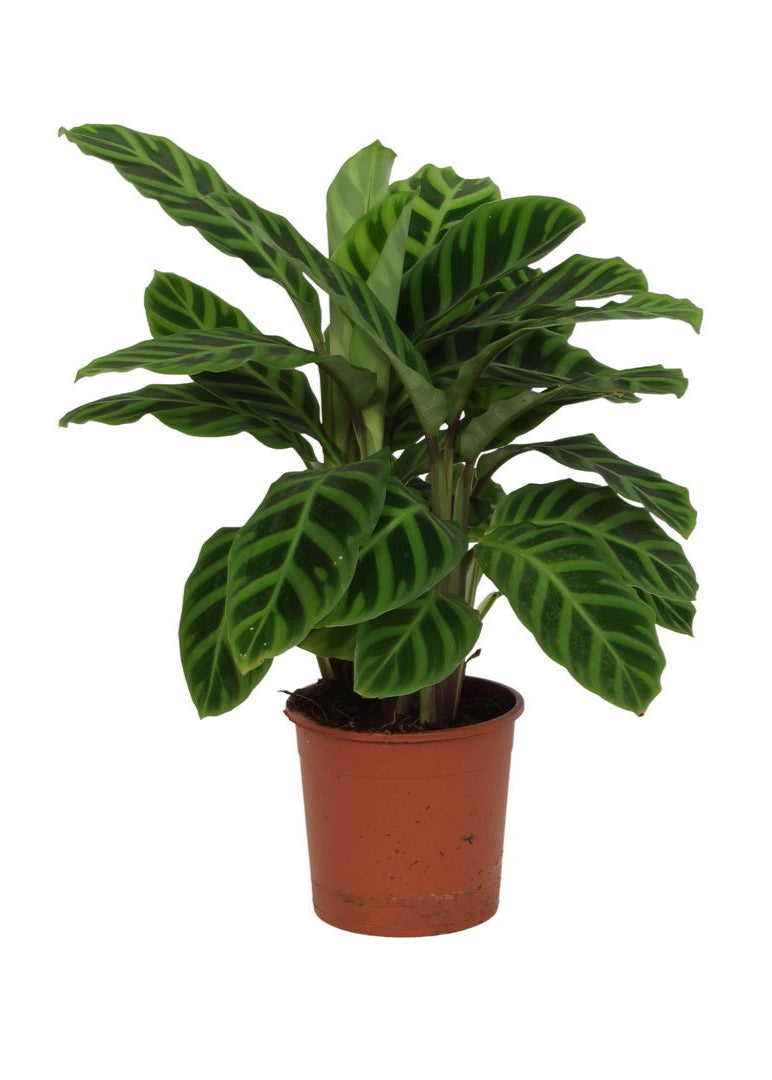
Goeppertia (Calathea) zebrina shows broad, velvety dark‑green leaves banded with bright lime‑green, zebra‑like stripes; the undersides are typically purplish, so a gentle turn of a leaf adds a two‑tone flash. The overall silhouette is an upright, tidy clump of large, elliptic leaves that read as bold but not spiky—often described in trade as the classic ‘zebra plant’.
This is an upright, clump‑forming species that does not climb or trail. Leaves enlarge as the plant matures and you may notice the familiar nightly leaf movement common to Marantaceae (the so‑called “prayer” motion). It grows from short rhizomes into a neat mound rather than sending long runners or producing leaf splits.
In everyday ownership the payoff is high visual contrast, but there are trade‑offs: it prefers consistently humid air and evenly kept substrate, and low humidity will show up quickly as brown leaf edges. It can also attract spider mites in persistently dry, heated rooms. Collectors prize it for its dramatic stripe pattern and velvety texture, yet it is commonly available in the horticultural trade rather than a rare novelty.
Supplied as a medium potted specimen (14 cm pot, medium size), it’s well suited to desks, shelves or compact corners where the striped leaves can be appreciated. This pot size makes the plant easy to place in apartment living without dominating a room.
Shipping Information
expand_more
- All orders are subject to a €25 minimum order value requirement
- All orders are hand-picked and shipped from the Netherlands
- Plastic-free materials when possible
- Orders are usually processed in 1-3 working days and shipped via DPD and their international partner carriers
- At times, orders may take up to 7 days to ship
- Orders to Germany Free shipping over €60. Free shipping all other EU countries* at €100 (Except Malta and Cyprus)
- Shipping costs are calculated at checkout based on delivery country:
See our FAQ and Shipping Guarantee for any further Questions!

Size: Medium - P14 H30


Plant questions, answered
Is the Goeppertia (Calathea) zebrina safe for homes with cats and dogs?
expand_more
Generally non-toxic to cats and dogs, though ingestion can still cause mild gastrointestinal upset. Veterinary-facing aggregators and horticultural guides list Goeppertia/Calathea species as non-toxic, but individual reactions vary. If a pet chews significant leaf material, contact your vet or a poison‑control service for advice.
What makes Goeppertia zebrina visually different from other striped houseplants?
expand_more
Goeppertia zebrina is defined by velvety dark‑green leaves with broad lime‑green zebra‑like bands and typically purplish undersides, creating a two‑tone effect. This contrasts with Goeppertia ornata’s fine pinstripes or Tradescantia zebrina’s trailing habit and different family; choose zebrina for bold, upright zebra striping in a clumping plant.
Will every leaf show the purple underside and the same stripe pattern?
expand_more
Leaves commonly have purplish to reddish undersides and bold longitudinal zebra stripes, but exact intensity and visibility vary between plants and leaves. Light, age and individual variability influence colour depth. Expect the characteristic two‑tone contrast, though no two leaves will match the product photo exactly.
What common problems should I watch for, and how does Goeppertia zebrina respond?
expand_more
Goeppertia zebrina responds poorly to low humidity, direct sun and waterlogging: brown leaf edges, spider mites and leaf bleaching are typical consequences. Maintain high humidity, avoid prolonged direct midday sun, and use a well‑draining mix to reduce root‑rot risk. Fluoride or chlorinated tap water can also cause tip browning.
What size plant will I receive when ordering the Medium option?
expand_more
You will receive the Medium variant listed as 'Medium - P14 H30' (potted in a 14 cm pot, height indicated as H30). Photographs show mature leaf character but pattern and exact height can vary between specimens; the variant describes the supplied pot size and the approximate plant category.
Plant care guide
Light
expand_more
Water
expand_more
Soil and repotting
expand_more
Humidity and temperature
expand_more
Feeding
expand_more
Growth and support
expand_more
Common concerns
expand_more
- Leaf edges browning: increase humidity and use filtered or rainwater if fluoride/chlorinated tap water is causing tip burn.
- Leaf bleaching/scorch: move out of direct midday sun to prevent bleached or scorched foliage.
- Pests (spider mites): raise humidity and inspect for sap-feeding pests in dry, heated indoor conditions; treat promptly if found.
- Root rot: avoid waterlogged soil and ensure a free-draining potting mix to prevent root decline.
Pet safety
expand_more
You might also like
Reviews in Other Languages
Cudeńko przyjechało