


Secure packaging for delicate plants
Small business in Berlin
★★★★★ 4.87 Avg. Review

Pilea Peperomioides 'Mojito'M
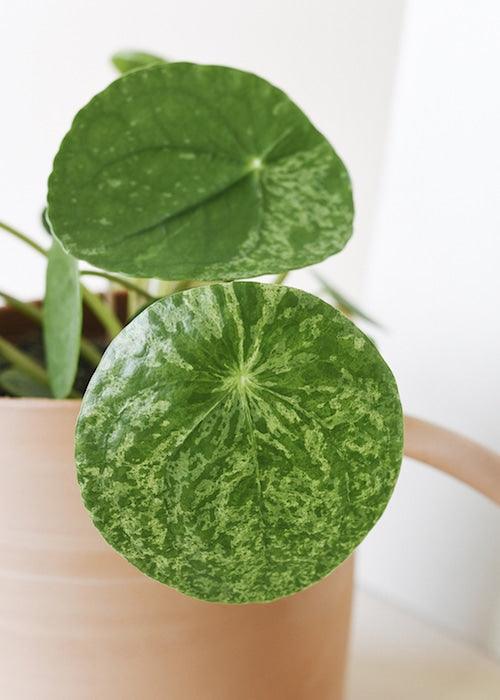
Pilea Peperomioides 'Mojito'M is a variegated selection of the Chinese money plant (Pilea peperomioides) distinguished by irregular cream-to-pale-green splashed, marbled variegation across its round, peltate (petiole attached near the centre) leaves. It grows as a self-heading, short-stemmed clumping houseplant that produces offsets, ideal for buyers wanting a decorative coin-leaf Pilea, but expect the variegation to be light-sensitive and sometimes to revert over time.
- height Height
- 20 cm
- swap_horiz Pot Size
- 13 cm
- volunteer_activism Care
- Medium
- wb_sunny Light Needs
- Bright indirect light
- pets Pet Friendly
- water_drop Watering Needs
- Medium
check_circle In Stock
Quick care table
Plant care at a glance
| Care factor | Pilea Peperomioides 'Mojito'M |
|---|---|
| Botanical name | Pilea peperomioides 'Mojito' |
| Common name | Chinese money plant, UFO plant, pancake plant, and Pilea Peperomioides 'Mojito'M |
| Difficulty | Medium |
| Light | Bright indirect light |
| Humidity | Medium |
| Pet safe | Yes, non-toxic to pets |
Speckled variegation on classic coin-shaped leaves
This selection shows the familiar round, coin-like leaves with the petiole attached near the centre, but each leaf carries irregular cream-to‑pale‑green splashes and fine marbling rather than large solid patches. Leaves are smooth with entire margins and are held on long petioles that create a radial, umbrella-like display; the cultivar name for this form is Pilea peperomioides 'Mojito'. Compared with the plain green Chinese money plant, Mojito’s appeal is purely decorative; compared with 'White Splash' it has smaller, looser marbling, and compared with 'Sugar' the flecks are coarser and less uniformly dotted.
Plants grow as a short-stemmed, self-heading clump that produces offsets (pups) rather than climbing or trailing vines. There’s no change in leaf shape between juvenile and mature stages beyond the normal size increase, and no fenestration—what you see early on is the overall habit you can expect. Variegation is the single novel trait here, but its expression can vary between pups and new growth.
In everyday ownership Mojito performs like the species: it prefers bright, indirect light and dislikes persistently wet roots. One honest limitation is variegation instability—low light, stress or successive pups can lead to reduced or reverted variegation, so appearance may change over time. Collectors value this form for its decorative foliage, though its variegation requires attention.
Best suited to a bright windowsill, shelf or desk where the pattern is visible. This listing is offered as a medium potted specimen, which gives an immediate display-ready plant that will produce pups you can keep or divide as it fills a small space.
Shipping Information
expand_more
- All orders are subject to a €25 minimum order value requirement
- All orders are hand-picked and shipped from the Netherlands
- Plastic-free materials when possible
- Orders are usually processed in 1-3 working days and shipped via DPD and their international partner carriers
- At times, orders may take up to 7 days to ship
- Orders to Germany Free shipping over €60. Free shipping all other EU countries* at €100 (Except Malta and Cyprus)
- Shipping costs are calculated at checkout based on delivery country:
See our FAQ and Shipping Guarantee for any further Questions!

Size: Medium - P13 H20
Plant questions, answered
What is Pilea peperomioides 'Mojito' and how does it differ from the regular Chinese money plant?
expand_more
It’s a selected variegated cultivar of Pilea peperomioides (Chinese money plant) distinguished by cream‑to‑pale‑green marbled or speckled variegation on the familiar round, peltate leaves. The basic habit and leaf shape match the standard green form, but 'Mojito' offers decorative variegation and similar cultural needs with added sensitivity of appearance.
How will the variegation look and will my plant keep the pattern?
expand_more
Leaves typically show irregular cream‑to‑pale‑green splashes or speckling rather than large solid sectors. Variegation expression can be variable between pups and new growth and may reduce or revert to plain green under low light or stress, so expect aesthetic variation and possible changes over time.
Does 'Mojito' need different care compared with a standard Pilea peperomioides?
expand_more
Care is broadly the same, but variegation is light‑sensitive. Bright, indirect light tends to increase variegation expression, while low light can cause fading or reversion; avoid harsh direct sun and persistently waterlogged soil. Practically, aim for slightly stronger indirect light than you might use for the plain green form.
Is Pilea peperomioides 'Mojito' safe for pets?
expand_more
Pilea species, including Pilea peperomioides, are listed as non‑toxic to cats and dogs by major pet‑safety sources. That species‑level evidence applies here, but it’s still sensible to discourage pets from chewing plants and to consult a veterinarian about any ingestion.
Is 'Mojito' rare or of interest to collectors, and what should buyers expect?
expand_more
It’s a sought‑after variegated selection prized for decorative foliage but not uniquely exclusive. Availability has been more limited than the plain form and it’s commonly sold by specialist nurseries. Collectors should expect attractive but sometimes unstable variegation and occasional reversion, which affects long‑term appearance and rarity perception.
Plant care guide
Light
expand_more
Water
expand_more
Soil and repotting
expand_more
Humidity and temperature
expand_more
Feeding
expand_more
Growth and support
expand_more
Common concerns
expand_more
Variegation can be unstable and may revert to plain green; variegation expression is sensitive to light and seasonal changes; susceptible to root rot if kept constantly wet or in poorly drained soil.
Pet safety
expand_more
You might also like
Very beatyful plant!