


Secure packaging for delicate plants
Small business in Berlin
★★★★★ 4.87 Avg. Review

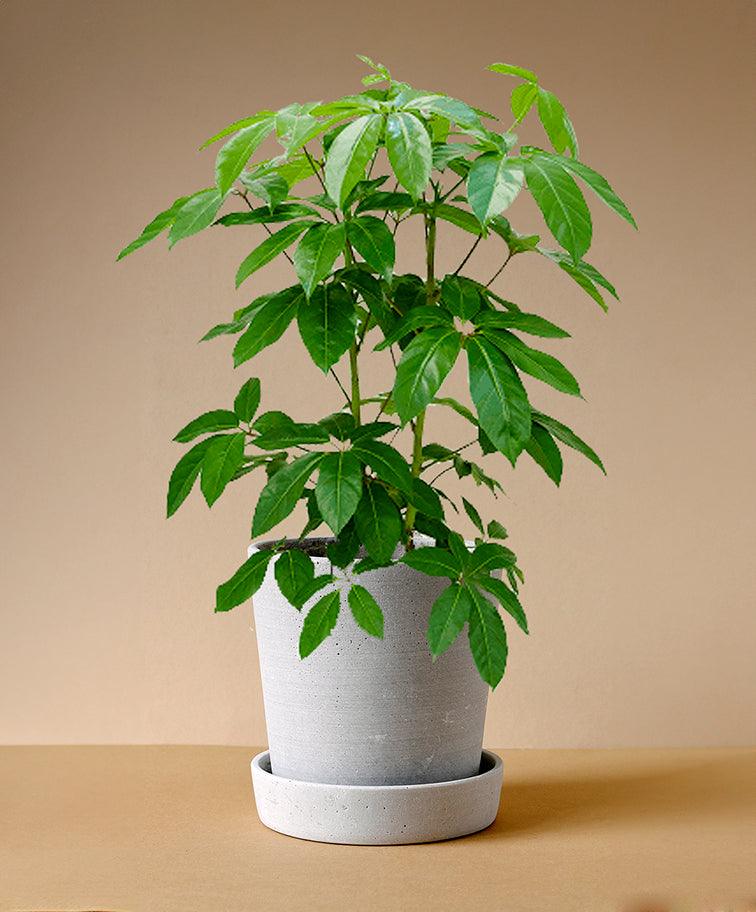
Schefflera Amate
Schefflera Amate (Schefflera actinophylla 'Amate') is an evergreen indoor specimen tree known for large, glossy palmately divided leaves—typically five long “fingers” that form an umbrella-like silhouette. It grows upright in a pot under bright indirect light, suits shoppers wanting a bold architectural houseplant, and is toxic to cats and dogs, so needs space and occasional pest checks.
- height Height
- 100 cm
- swap_horiz Pot Size
- 24 cm
- volunteer_activism Care
- Medium
- wb_sunny Light Needs
- Indirect light
- pets Not Pet Friendly
- water_drop Watering Needs
- Medium
cancel Sold out
Quick care table
Plant care at a glance
- Botanical name
- Schefflera actinophylla 'Amate' (trade usage; some taxonomic treatments place the species in Heptapleurum as Heptapleurum actinophyllum)
- Common name
- Amate, Umbrella tree, and Umbrella plant
- Difficulty
- Medium
- Light
- Indirect light
- Water
- Medium
- Humidity
- Medium
- Pet safe
- No, toxic if ingested
- Growth habit
- Evergreen Upright shrub/tree with umbrella-like canopy (used as indoor specimen/container tree).
- Best for
- Bedroom, Living room, and Office
Large glossy, palmately divided leaves — Schefflera Amate
This is a selected commercial cultivar prized for its bold, palmately arranged leaves that open like an umbrella. Each leaf typically has about five long, elliptic leaflets with a glossy, hairless upper surface, long petioles and clear radiating veins that create a circular, hand‑like silhouette. The overall effect is a strong, tropical architectural canopy rather than a fine-textured houseplant.
As an indoor specimen it develops as an upright, tree-like form rather than a trailer or climber. Leaf size, internode length and overall compactness respond to pot size and light: larger pots and brighter conditions usually produce bigger leaflets and a looser habit. You will rarely see the dark-red flowers that occur in the wild on indoor specimens.
In real homes the Amate behaves as a vigorous, space‑needing tree: it grows steadily, benefits from bright indirect light and moderate moisture, and will demand occasional pest checks for spider mites, mealybug or scale. One honest trade-off is that it is not pet-safe — it contains calcium oxalate crystals that are toxic to cats and dogs — and it can show leaf-tip browning if humidity or feeding is wrong.
Best for rooms with height and a clear corner, the cultivar fits living rooms, halls or office spaces where a larger indoor tree is wanted. Supplied as a larger specimen in trade, bigger pots give immediate presence, while smaller nursery sizes would be easier to move and shape over time.
Shipping Information
expand_more
- All orders are subject to a €25 minimum order value requirement
- All orders are hand-picked and shipped from the Netherlands
- Plastic-free materials when possible
- Orders are usually processed in 1-3 working days and shipped via DPD and their international partner carriers
- At times, orders may take up to 7 days to ship
- Orders to Germany Free shipping over €60. Free shipping all other EU countries* at €100 (Except Malta and Cyprus)
- Shipping costs are calculated at checkout based on delivery country:
See our FAQ and Shipping Guarantee for any further Questions!

Size: XXL - P24 H100
Plant questions, answered
Is Schefflera Amate suitable for indoor spaces and where should I place it?
expand_more
Yes — Schefflera actinophylla 'Amate' is commonly grown as an indoor specimen. Place the Amate in bright, indirect light with medium humidity and moderate watering; it needs room to develop its umbrella-like canopy. Allow space for its upright, tree-like habit and check for pests occasionally.
What makes Amate different from other umbrella-tree selections like Schefflera arboricola?
expand_more
Schefflera Amate is a selected cultivar notable for larger, glossy palmately compound leaves (commonly five long elliptic leaflets) and a more tree-like upright habit. Compared with dwarf S. arboricola, Amate gives a stronger tropical architectural presence; it’s an established trade selection documented in plant-patent literature.
Is Schefflera Amate safe for homes with pets?
expand_more
No — Schefflera actinophylla 'Amate' contains insoluble calcium oxalate crystals and is listed as toxic to cats and dogs. Keep the plant out of reach of pets, and seek veterinary advice immediately if ingestion is suspected. Treat the Amate as not pet-friendly.
What pests or problems should I watch for with Schefflera Amate?
expand_more
Expect occasional spider mites, mealybugs and scale on Schefflera Amate in indoor conditions. Leaf-tip browning can result from low humidity or over-fertilisation, and overwatering causes root issues. Inspect leaf undersides regularly, maintain moderate humidity, and avoid waterlogged soil to reduce risk.
What size plant will I receive when I order Schefflera Amate?
expand_more
You will receive the XXL variant: supplied in a 24 cm pot and listed at approximately 100 cm height. Leaf size, internode length and overall compactness can still vary with light and growing conditions, so expect natural variation in foliage spread and trunk development.
Plant care guide
Light
expand_more
Water
expand_more
Soil and repotting
expand_more
Humidity and temperature
expand_more
Feeding
expand_more
Growth and support
expand_more
Common concerns
expand_more
- Pests: susceptible to spider mites, mealybugs and scale—inspect regularly and treat infestations promptly.
- Leaf browning: leaf-tip browning can result from low humidity or over-fertilisation—raise humidity or reduce feed and prune browned tips.
- Overwatering: waterlogged soil can cause root problems—ensure good drainage and avoid keeping the pot constantly waterlogged.