


Secure packaging for delicate plants
Small business in Berlin
★★★★★ 4.87 Avg. Review

Aglaonema Pictum Tricolor
Aglaonema Pictum Tricolor is a compact clumping Chinese evergreen prized for its three-toned “camouflage” variegation of dark green, lighter green and silvery-white. Indoors it forms a low rosette on short stems and suits collectors or houseplant owners prepared to provide steady warmth and higher humidity for stable patterning; note it contains calcium oxalate crystals and is toxic if chewed, so keep away from pets and children.
- height Height
- 10 cm
- swap_horiz Pot Size
- 6 cm
- volunteer_activism Care
- Medium
- wb_sunny Light Needs
- Low light
- water_drop Watering Needs
- Medium
cancel Sold out
Quick care table
Plant care at a glance
| Care factor | Aglaonema Pictum Tricolor |
|---|---|
| Botanical name | Aglaonema 'Pictum Tricolor' |
| Common name | Chinese evergreen, Aglaonema pictum 'Tricolor', Aglaonema, and Chinese evergreen 'Pictum Tricolor' |
| Difficulty | Medium |
| Light | Low light |
| Humidity | Medium |
| Best for | Hallway, Living room, Indoors, and Bathroom |
Three-toned camouflage foliage, collector's Aglaonema selection
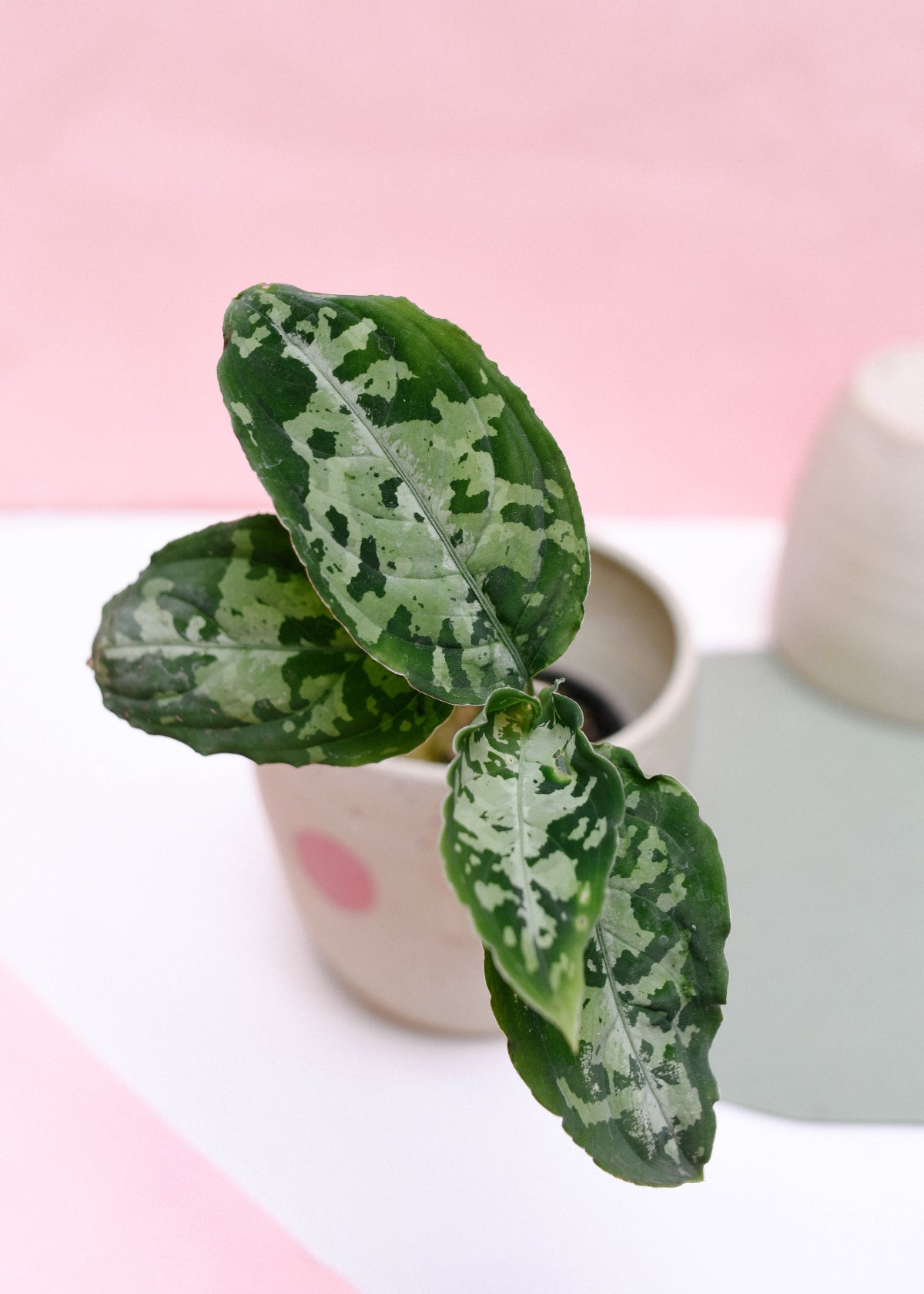
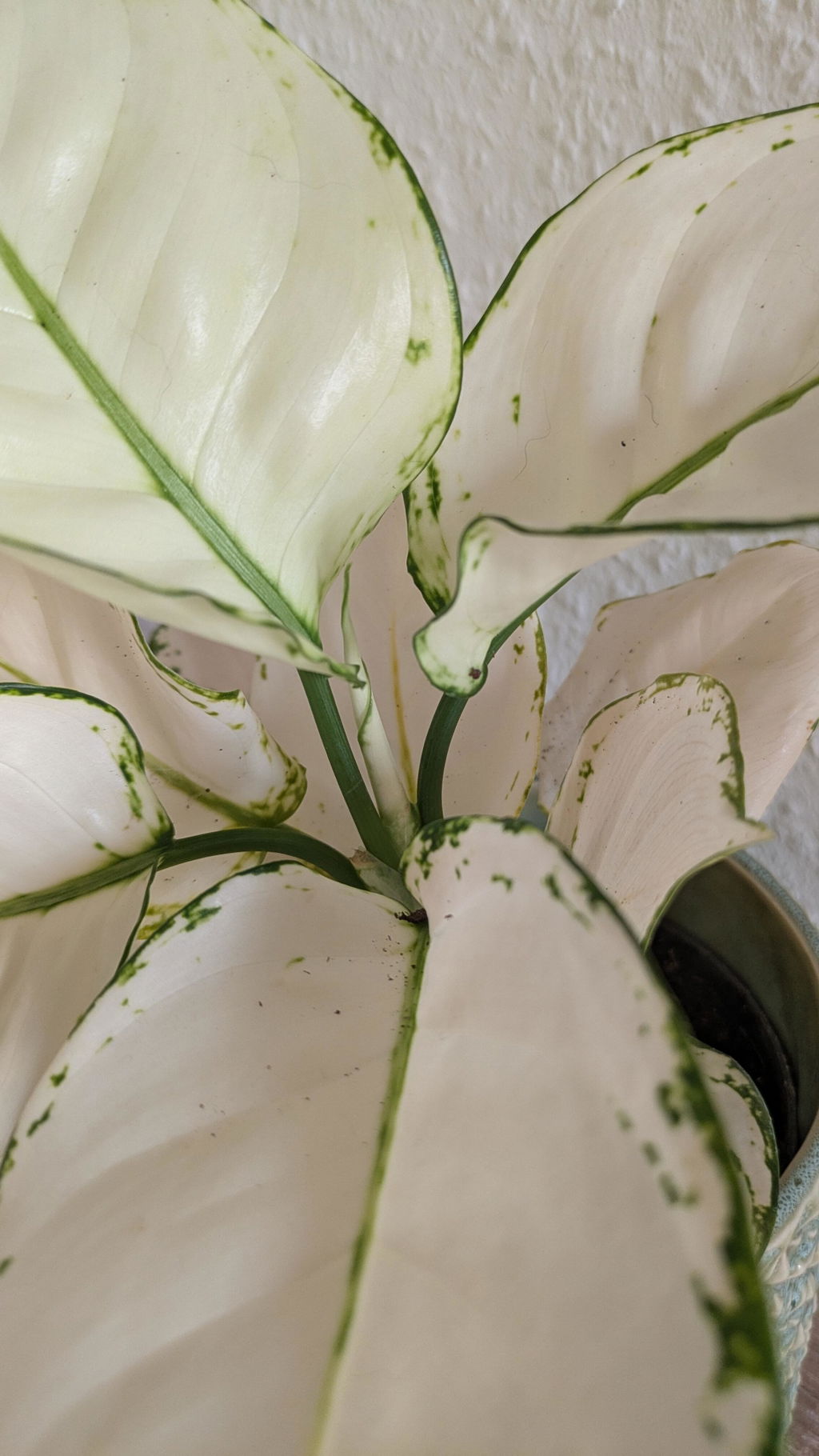
The leaves form a low, compact mound of lanceolate, leathery foliage patterned in an irregular three‑toned mosaic — dark green, lighter green and pale silvery‑white patches and speckles across each leaf create a camouflage effect that changes from leaf to leaf. The midrib is usually visible but not strongly contrasting, so the overall silhouette reads as a textured, variegated rosette rather than a striped or edged leaf plant. This selection is sold as Aglaonema Pictum Tricolor.
Development stays conservative indoors: plants remain clumping and short‑stemmed, producing new leaves on short cane‑like stems rather than climbing or developing splits. Variegation does not convert into a different leaf form with age — the spotting and blotches persist from juvenile to mature leaves — but the strength of the trichromatic pattern can vary with growing conditions, so contrast may look stronger on well‑expressed specimens. There is no fenestration or adult leaf splitting to expect.
In everyday ownership this is a collector‑oriented choice: it benefits from a stable, humid microclimate and bright, indirect light to show its best contrast, and buyers should expect sensitivity to sudden change (shipping or repotting can cause leaf melt). The product snapshot lists tissue‑cultured “baby” plants; these TC starts are pest‑free and genetically consistent but can be slower to establish as they develop a stable root system.
Best suited to humid indoor niches — terrariums, humid bathrooms or carefully managed display shelves — it differs from a typical A. pictum by offering a more complex three‑tone camouflage than the simpler spotting of standard pictum forms. Supplied as a baby specimen, the purchase is a collector’s entry rather than an instant large display.
Shipping Information
expand_more
- All orders are subject to a €25 minimum order value requirement
- All orders are hand-picked and shipped from the Netherlands
- Plastic-free materials when possible
- Orders are usually processed in 1-3 working days and shipped via DPD and their international partner carriers
- At times, orders may take up to 7 days to ship
- Orders to Germany Free shipping over €60. Free shipping all other EU countries* at €100 (Except Malta and Cyprus)
- Shipping costs are calculated at checkout based on delivery country:
See our FAQ and Shipping Guarantee for any further Questions!
Size: Baby - P6 H10
Plant questions, answered
What makes Aglaonema pictum 'Tricolor' different from other Aglaonema selections?
expand_more
Aglaonema pictum 'Tricolor' is a selected cultivar recognised for its three-toned “camouflage” mosaic—dark green, lighter green and silvery-white—across each leaf. This trichromatic pattern is more complex than typical pictum or bicolour Aglaonema forms. For buyers this means a visually striking, collector-oriented plant that benefits from steadier conditions to keep its variegation crisp.
Is Aglaonema pictum 'Tricolor' suitable for a typical European home environment?
expand_more
It can be grown in many European homes but prefers consistently warm, humid conditions and bright indirect light. Aglaonema pictum 'Tricolor' does best with stable temperatures (around typical indoor warmth), higher humidity (~60–85%) and no cold draughts. In lower-humidity homes you may need a terrarium, humidity tray or grouping with other plants to support strong foliar display.
Will the leaf variegation stay the same as in product photos?
expand_more
The trichromatic variegation is genetic but its expression is environmentally sensitive, so individual leaves and plants will vary. Aglaonema pictum 'Tricolor' may show reduced contrast under low light, stress or fluctuating conditions; conversely, steady warmth and humidity help maintain crisp patterning. Expect natural variation rather than an exact match to any single photo.
How should I acclimatise my Aglaonema pictum 'Tricolor' after arrival to avoid leaf melt?
expand_more
Do not repot immediately; allow the plant to acclimatise for 2–4 weeks in stable conditions (warm, bright indirect light and elevated humidity). Keep the aroid substrate evenly moist but not waterlogged to prevent shock-induced leaf melt. Wait to make major changes—like repotting or feeding—until the plant shows new, healthy growth.
Is Aglaonema pictum 'Tricolor' safe around pets and children?
expand_more
Aglaonema pictum 'Tricolor' is toxic if ingested due to insoluble calcium oxalate crystals and can cause oral irritation, drooling and vomiting. Severity varies with amount eaten; keep the plant well out of reach, supervise curious pets and children, and handle foliage with care (gloves if needed).
Plant care guide
Light
expand_more
Water
expand_more
Soil and repotting
expand_more
Humidity and temperature
expand_more
Feeding
expand_more
Growth and support
expand_more
Common concerns
expand_more
Key issues: leaf melt or shock after shipping/repotting (allow acclimatisation); loss or fading of variegation under low light or stress; root‑rot from persistently wet, poorly aerated mixes; sensitivity to cold drafts and rapid temperature swings; occasional sap‑feeding pests (mealybugs, scale) on stressed plants.
Pet safety
expand_more
You might also like
The Aglaonema Red Zircon arrived safely and was well packed. The plant is healthy and pretty, but the color is quite different from the product photo. In the photo it looked more pink, while in real life it has more red spots and looks less pink than expected. It is still a nice plant, but not exactly what I expected from the listing photo.
Geniale und gedunde Pflanze
Plant arrived promptly and in very good condition. Was true to the photograph on the website.
Lovely, healthy plant, slightly smaller that expected, though
Everything is fine.
Reviews in Other Languages
Pianta sana, imballata con cura. Ordine evaso celermente. Spedizione arrivata in poco tempo in Italia. Ottimo negozio.
Diese wunderschöne Aglaonema durfte bei mir einziehen und treibt schon ein neues Blatt aus. Zwei der älteren Blätter sind gelb geworden, aber sonst entwickelt sie sich super
Muy sana y grande