

Secure packaging for delicate plants
Small business in Berlin
★★★★★ 4.87 Avg. Review


Ficus elastica 'Belize'
Ficus elastica 'Belize' is a tricolour rubber plant with an upright, columnar habit and distinctive pink-to-red venation and petioles that give new leaves a blush-pink tone. Sold as a compact potted houseplant that can develop taller single- or multi-stem growth indoors, it suits collectors and style-conscious buyers seeking warmer variegation than 'Tineke', but it is not safe for homes with curious pets due to irritating latex sap.
- height Height
- 30 cm
- swap_horiz Pot Size
- 12 cm
- volunteer_activism Care
- Easy
- wb_sunny Light Needs
- Indirect light
- pets Not Pet Friendly
- water_drop Watering Needs
- Medium
check_circle In Stock
Quick care table
Plant care at a glance
- Botanical name
- Ficus elastica 'Belize'
- Common name
- Ficus elastica 'Belize', Belize rubber plant, rubber plant, and rubber tree
- Difficulty
- Easy
- Light
- Indirect light
- Water
- Medium
- Humidity
- Medium
- Pet safe
- No, toxic if ingested
- Best for
- Living room, Hallway, and Bedroom
Ficus elastica 'Belize' — pink‑blushed tricolour foliage
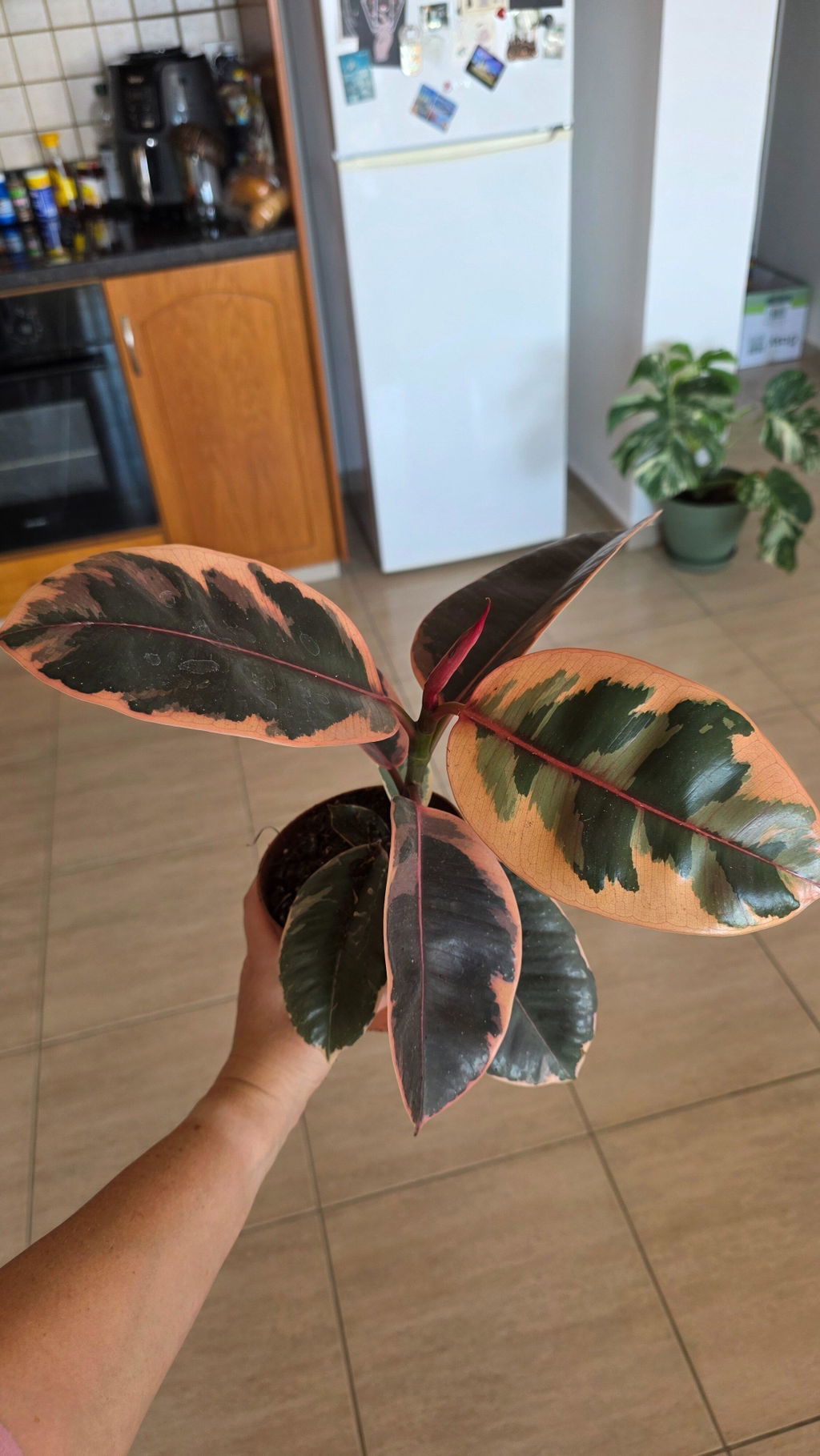
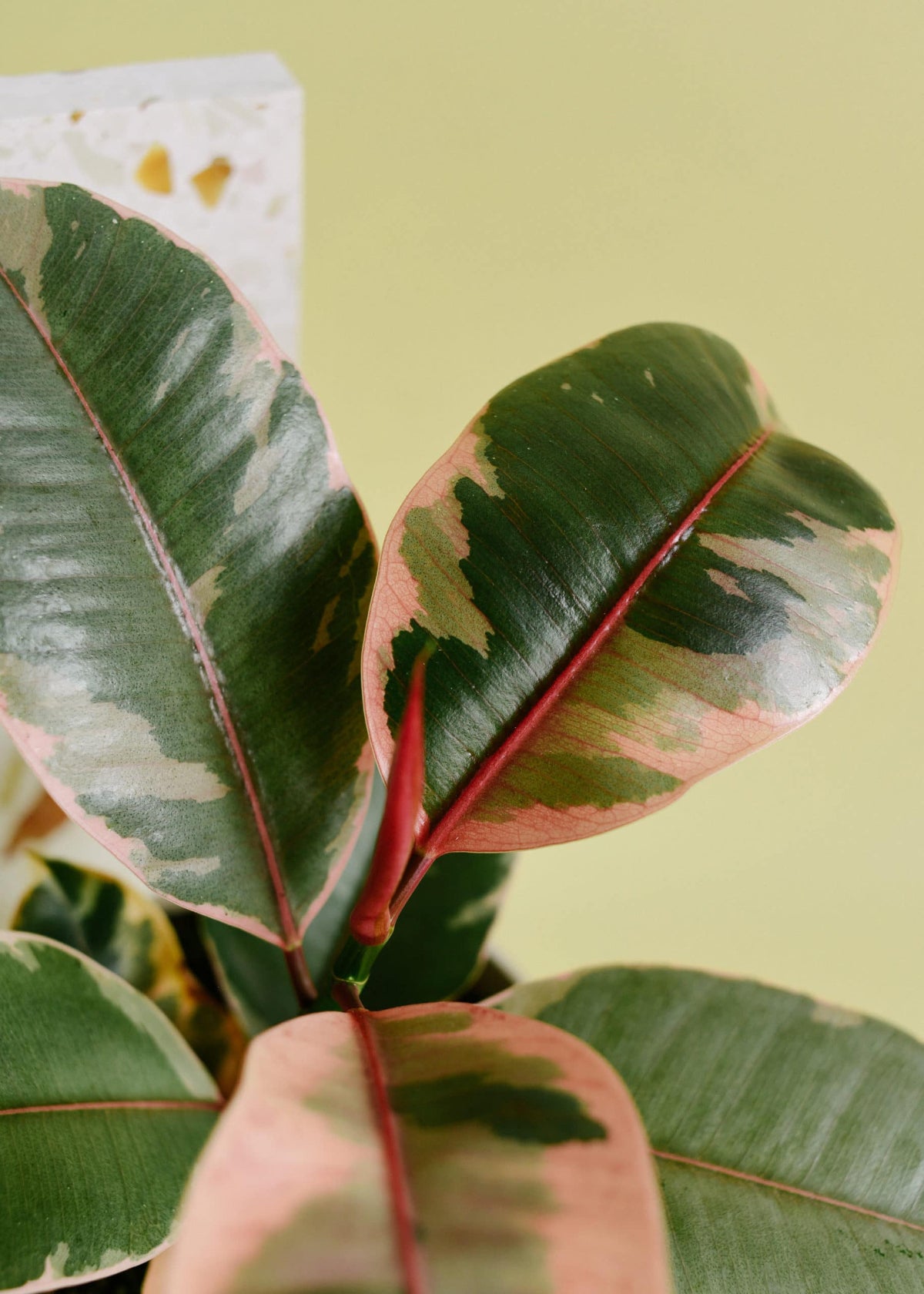
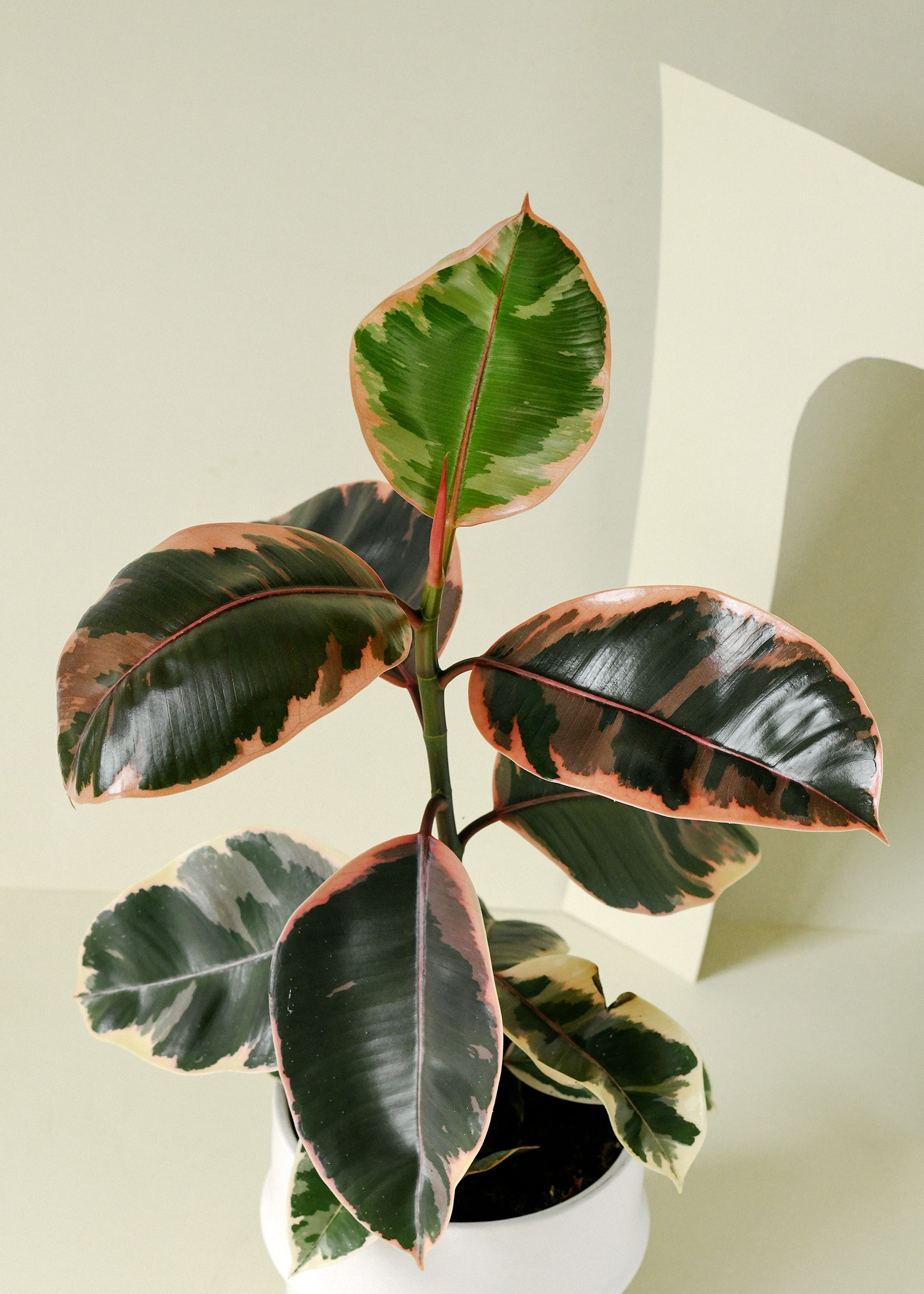
This cultivar is defined by its irregular tricolour leaves: deep green, cream and a noticeable pink to red‑blush on new growth. Leaves are broadly ovate, glossy and leathery with a red‑purple midrib and petiole that gives a warm, sunset‑toned look across the plant. Each leaf is unique, so the overall effect is lively and variegated rather than perfectly patterned.
Indoors it keeps an upright, columnar habit but is commonly sold as a compact potted specimen; new leaves tend to emerge with the strongest pink tones and often mature toward cream and green sectors. If left to grow long term it can develop longer canes or a multi‑stem form, and light pinching will encourage a couple of lateral branches rather than a single bare stem.
Expect straightforward, moderate upkeep: bright, indirect light preserves the variegation and overwatering will show as yellow leaves, so avoid waterlogged mix. One honest trade‑off is that the coloured sectors are sensitive to strong midday sun and low humidity can brown edges on variegated margins. Be aware the plant contains milky sap that can irritate skin and is considered toxic to pets.
Best for small to medium indoor spots where a compact, colourful leaf texture is wanted — shelves, side tables or near an east/west window. This listing is supplied as a medium, compact pot (12 cm pot, ~30 cm height), which makes it easy to trial the cultivar’s pink venation in tighter spaces.
Shipping Information
expand_more
- All orders are subject to a €25 minimum order value requirement
- All orders are hand-picked and shipped from the Netherlands
- Plastic-free materials when possible
- Orders are usually processed in 1-3 working days and shipped via DPD and their international partner carriers
- At times, orders may take up to 7 days to ship
- Orders to Germany Free shipping over €60. Free shipping all other EU countries* at €100 (Except Malta and Cyprus)
- Shipping costs are calculated at checkout based on delivery country:
See our FAQ and Shipping Guarantee for any further Questions!

Size: Medium - P12 H30


Plant questions, answered
What makes Ficus elastica 'Belize' different from other rubber plants?
expand_more
Ficus elastica 'Belize' is a sport mutation notable for pink/red‑purple venation and petioles plus irregular tricolour leaves (green, cream and pink). It was selected as a naturally occurring mutation and documented in a plant patent, so the pink tones and coloured veins are stable in asexually propagated plants — an aesthetic choice for buyers.
How does the variegation change as leaves develop on Ficus elastica 'Belize'?
expand_more
New leaves on Ficus elastica 'Belize' often show the strongest pink or red‑blush, which can mature into cream/white and green sectors as the leaf expands. Variegation is irregular and leaf‑by‑leaf, so expect each leaf to look different and some seasonal or light‑related variation in intensity.
How does 'Belize' compare to Ficus elastica 'Tineke'?
expand_more
'Belize' differs from Ficus elastica 'Tineke' chiefly by red‑purple venation and petiole colour and pink tones on new growth; 'Tineke' shows green plus white variegation with lighter veins. Choose 'Belize' if you prefer warmer pink/red accents rather than the cooler green‑and‑white palette.
Is Ficus elastica 'Belize' safe around pets and children?
expand_more
No — Ficus elastica 'Belize' contains milky latex sap that can irritate skin and mucous membranes and is considered toxic to cats and dogs. Keep Ficus elastica 'Belize' out of reach of curious pets and children and avoid contact with the sap if pruning or propagating.
What size will I receive and is this plant suitable for small apartments?
expand_more
You will receive the Medium - P12 H30 option listed (pot size 12 cm, approx. 30 cm height) as a compact potted specimen. Ficus elastica 'Belize' is commonly sold as a space‑saving, upright houseplant suitable for shelves, desks or side tables, though it can be staked or trained if allowed to grow taller.
Plant care guide
Light
expand_more
Water
expand_more
Soil and repotting
expand_more
Humidity and temperature
expand_more
Feeding
expand_more
Growth and support
expand_more
Common concerns
expand_more
Overwatering → yellowing leaves and root rot; brown leaf edges from low humidity or underwatering; watch for spider mites and scale on foliage.
Pet safety
expand_more
You might also like
I've ordered from this shop twice. The packaging is insane. I live in cyprus and it takes about a week to come to me. Plants are all so healthy. The only one plant which didn't survive much was peperomia ive ordered but that was clearly during the transport. As all leaves came off but I guess its a sensitive plant. All others are thriving and already pushing new growth. I coudnt ve more happier